

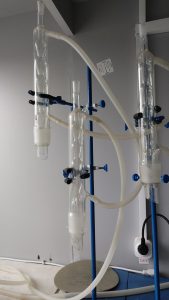
 Соняшникова макуха є цінним кормовим продуктом, і її лабораторний аналіз проводиться для визначення якості та безпечності. Ось основні аспекти такого аналізу:
Мета лабораторного аналізу соняшникової макухи:
- Determination of nutritional value: Evaluation of protein content, fat, tissue, moisture, ashes, vitamins and minerals.
- Detection of harmful impurities: Checking for the presence of toxic items (Heavy metals), mycotoxins, Pesticide residues, radionuclides and other contaminants.
- Quality control: Порівняння отриманих результатів із встановленими стандартами (for example, DSTU 4638:2006).
- Assessment of the degree of processing: Determination of urease activity (хоча цей показник менш актуальний для соняшникової макухи, ніж для соєвої).
The main indicators, які визначаються під час лабораторного аналізу соняшникової макухи:
- Mass fraction of crude protein in terms of absolutely dry substance.
- Mass fraction of raw tissue in low -fat product in terms of absolutely dry substance.
- Mass fraction of moisture and volatile substances.
- Mass fraction of raw fat in terms of absolutely dry substance.
- Масова частка золи в перерахунку на абсолютно суху речовину.
- The content of toxic elements (lead, cadmium, mercury).
- The content of mycotoxins (deoxynivalenol, zearalenone, T-2 toxin).
- Pesticide residues.
- Radionuclides.
- Granularity and the presence of other impurities (насіння бур’янів, металомагнітні домішки).
- Organoleptic indicators (color, scent, наявність плісняви).
Methods of laboratory analysis:
Various methods are used to determine these indicators, including:
- Chemical methods: K'jeldahl method (for protein determination), extraction methods (to determine fat), titrimetric methods, spectrophotometry, etc.
- Physico-chemical methods: Drying (to determine moisture), burning (to determine the ash).
- Instrumental methods: Gas and liquid chromatography (to determine pesticides, mycotoxins), Atomic-absorption spectrometry (To determine heavy metals), Radiometric methods (to determine radionuclides).
- Microscopic methods: To detect mold, fungi and other impurities.
- Organoleptic analysis: Visual evaluation and evaluation of smell.
The results of laboratory analysis are issued in the form of test protocol, which is an official document, що підтверджує якість та безпечність соняшникової макухи.